The details nobody notices.
Building a Mumbai you can feel at 300 km/h.
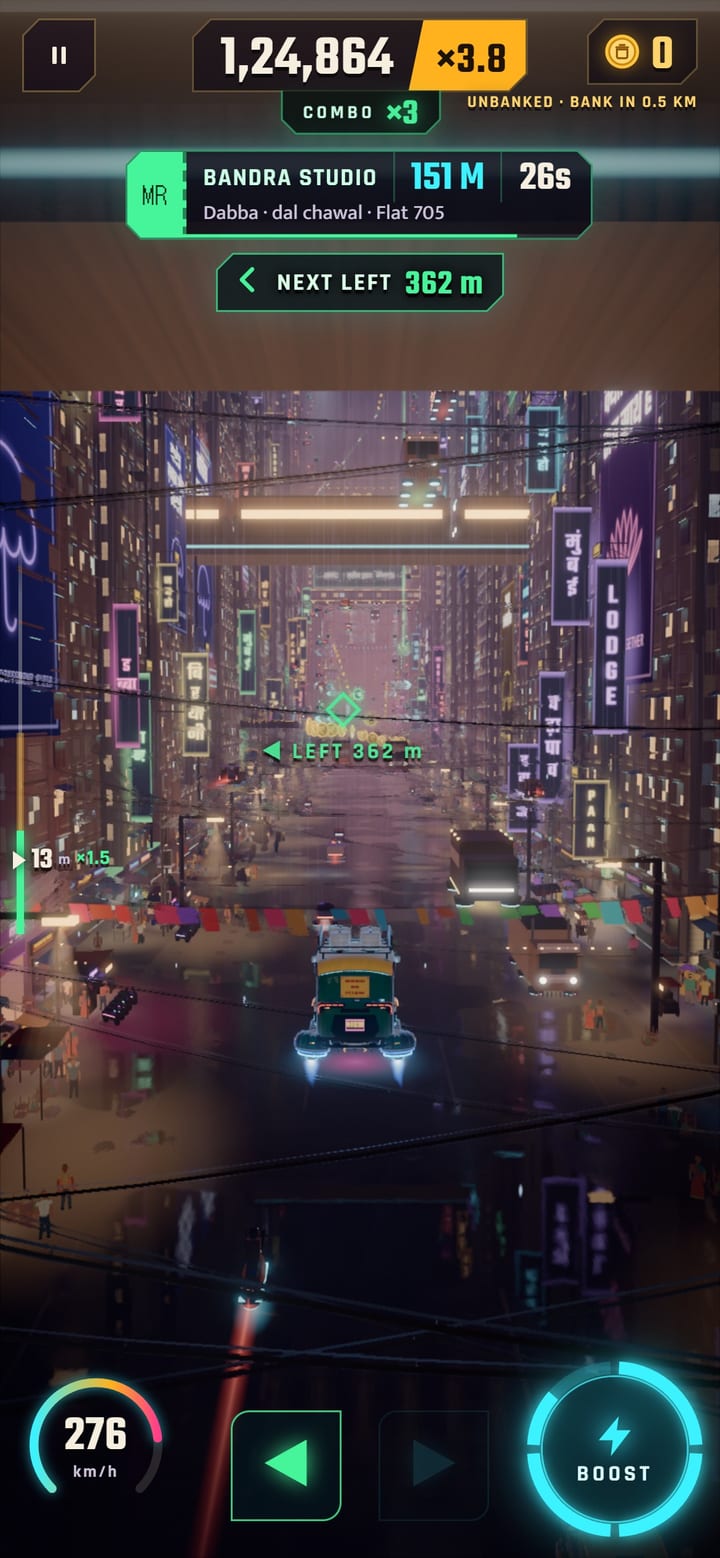
Rain on the glass. A neon street drops away under you, signs in two scripts climbing both walls, and somewhere below, a market that hasn't noticed the traffic flying over it. There's a dabba strapped to the rack behind your head. Aunty D'Souza has ordered dal chawal for flat 705, and the clock says thirty seconds.
That's Dabba Dash. You fly a hover auto-rickshaw through Neo-Mumbai in the monsoon of 2099, and you deliver lunch.
The idea
Mumbai's dabbawalas carry lunch across the city every day and almost never get one wrong. I wanted to give that job a future. So: Mumbai, 2099, the monsoon still on, the towers stacked so high that the streets have become canyons, and the dabba riding in the one vehicle that has always gone everywhere in this city. The auto has HORN OK PLEASE on its back and the plate MH 01 DD 2099, because a future auto is still an auto.
The traffic keeps left. It's Mumbai.
A city with a memory
The whole route grows from one number. Give the game the same seed and it gives you the same city: the same junctions, the same jams, the same festival on the same corner. A city you can come back to has a memory, and a moment in it can be replayed exactly.
But a city that's the same everywhere isn't a city, so each district has its own mood, and the sky and the fog change as you cross into it. Dadar is a vertical bazaar with a sign on every surface. Dharavi stacks its homes with overhangs and gullies, and the wires are thickest there. The Girgaon chawls hang their laundry across the street. BKC is glass with LED edges, and the wires are gone. Marine Drive Heights has art deco on one side and the Queen's Necklace on the other: a lamp every 12 m, strung with warm gold bulbs, over the Arabian Sea. The Sea Link is a storm.
Then the towers step aside for a maidan: a Ganesh festival with a hologram over the stage, a floodlit night match under four 44 m lattice towers with LED bails on the stumps, a dhobi ghat with the washermen beating the washing beside steaming boilers. The grounds sit on decks up in the flight band, so you pass them at eye level while the street underneath stays a canyon of shops.
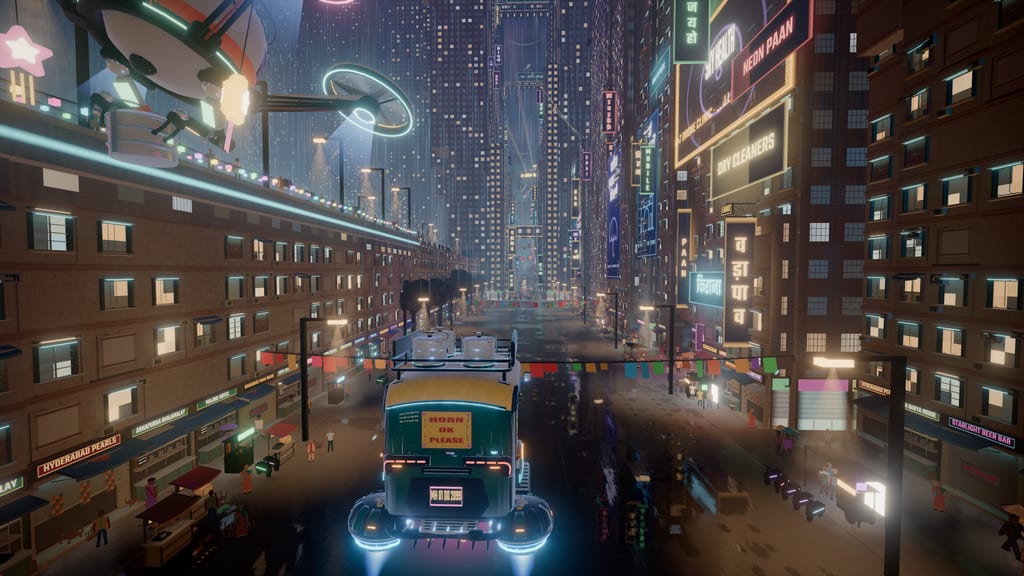
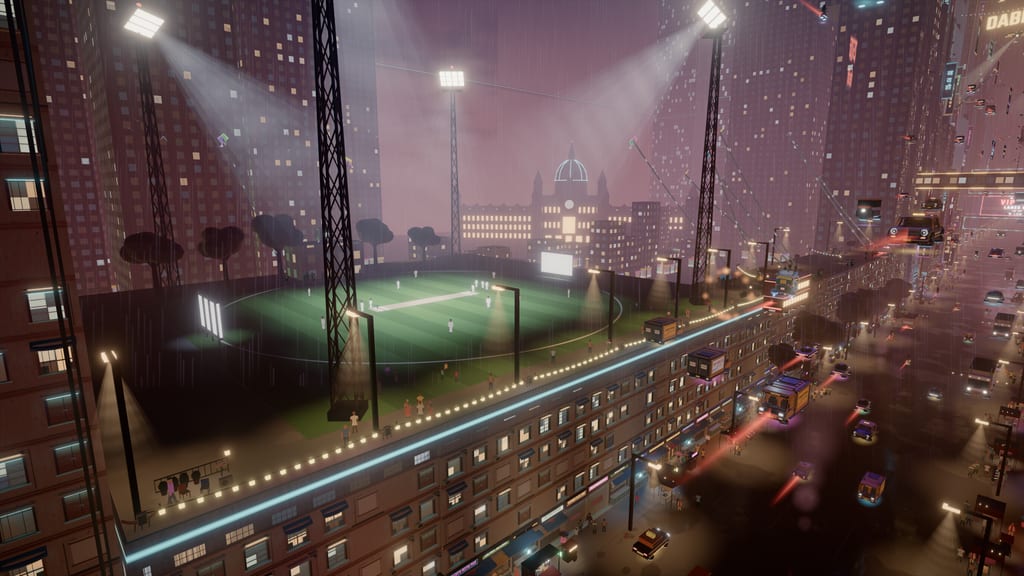
The roofs are lived on: lit terraces, chai corners under tarps, kites. The ledges on the walls carry chai stalls, and the customers' parked autos are solid, because lived in means obstacles with a story.
Speed is a feeling, not a number
Your stomach reads speed before your eyes do, so the work went into the things your stomach reads.
When the boost lights, each nozzle flashes white, a shock ring bursts along the exhausts, the flames overshoot and settle, and the lens punches wider and eases back. A boost should feel like a kick in the back, not a number going up. From about 200 km/h, specks of air streak past the edge of the frame, because speed reads best at the edge of your vision.
The auto has a body. In a hard strafe it banks up to about 30° on a spring: it rolls in, overshoots a touch and settles. It noses into a dodge, pitches as it climbs or dives, and the pods under it burn harder on the side doing the pushing, so you can see which pods are working. The camera lets the auto swing across the frame, leads a little into the move and rolls with a fraction of the lean. Weight is what makes a machine believable.
A retry picks up at the pace you had reached, because being sent back to a crawl after a crash is a punishment nobody asked for.
Pass within 1.2 m of something and it's a CLOSE SHAVE (बाल-बाल!, a narrow escape) for double points. Skim a car that close and its driver will often lean on the horn. Fair enough.
Controls are a promise
A game can be hard. It must never be unfair, and the first unfairness is your own controls betraying you.
At first, a hard swerve towards a side street and a turn were the same gesture: you'd dodge a bus and find yourself halfway down a gully you never meant to enter. So a turn is a deliberate act: a tap on ◀ or ▶ when a junction is ahead, and the arrow blinks saffron like an auto's indicator while the turn is held. Tap it again to cancel. A dodge never turns you.
Ask for the corner on the approach and the auto takes an arc that ends on the side street's centre line, whatever your speed. Hold the arrow and it hops and noses in before it turns. A clean one is a PERFECT DRIFT (शाबाश!, well done), with a burst of pace out of the corner.
On a phone your thumb is the steering, and you can't control what you can't see. So the touch guide stays where your finger landed and draws a tether to it, and you can feel how far you've dragged without looking down.
The clock is fair. Every delivery gets thirty seconds, and its drop ring is placed about a nineteen-second flight away at your current speed. Fly faster and the tip is bigger. Skill should pay, visibly.
Boost lives in four cells. Coins, near misses and drifts fill them, and a scrape cracks one. At four of four the next boost is OVERDRIVE (तूफ़ान!, a storm): every cell spent at once, and a shockwave clears the traffic ahead. Risk and reward, on one dial.
Feel is never finished. Every build gets played on a phone, and the controls keep moving towards the same target: quick to read, fair, and a little heavy, like a real machine.
Humour is world-building
A city is believable when it's a little absurd, and Mumbai supplies the material.
Everyone here knows the wire jungle: the tangle of cables over the older streets, a kite caught in it, a pair of slippers hanging where nobody can explain. Thin wires sting. Thick ones snag, and a lamp or a mirror tears off and tumbles away. Fly into a trunk line and the auto hangs in the bundle with its jets dead, and the block goes dark for about 135 m in each direction: POWER CUT (बत्ती गुल!, the lights are gone). The crash camera turns to moonlight, and in the dead windows the phone torches and inverter lights come on. The results card adds a line like "Somewhere a mixer grinder stopped mid-chutney." A power cut is the most Mumbai way to crash.
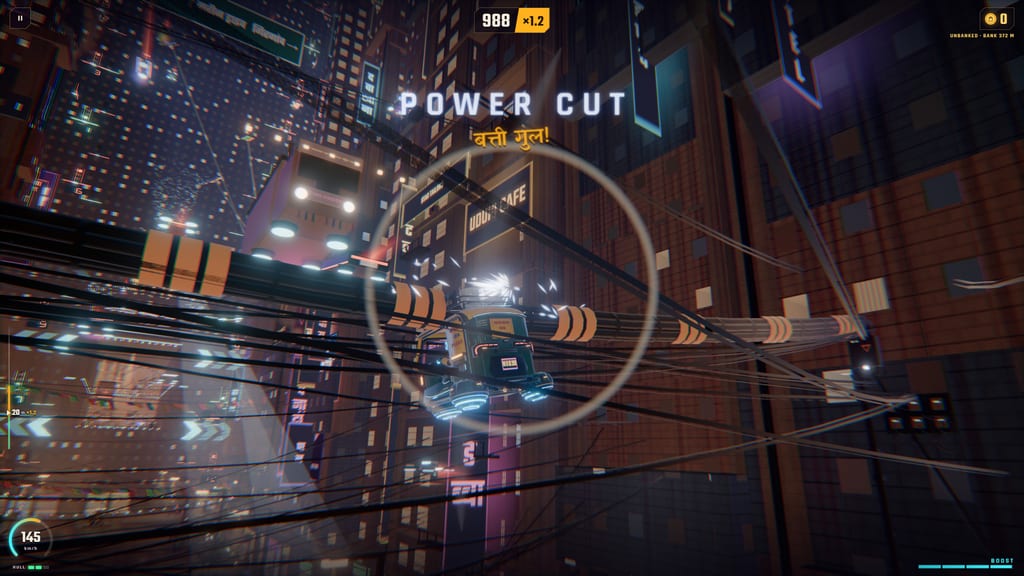
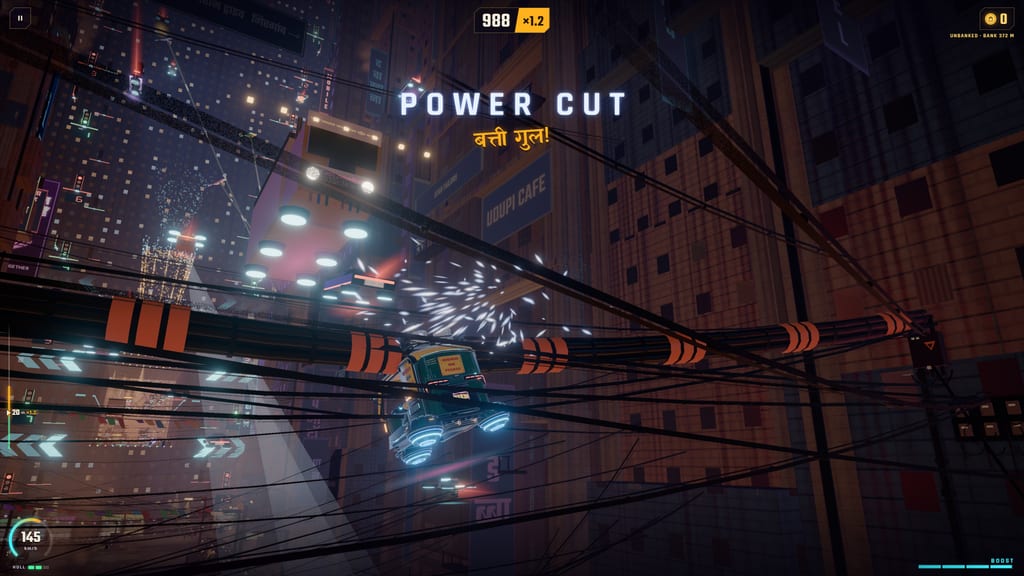
Now and then Sky Patrol closes the lanes for a VIP: barricades, a jam with an ambulance stuck in it, officers with lit batons, and a convoy coming at you down the one open lane with its hooter going. You go over the jam or under the lane, and Monsoon FM's traffic desk can't help itself: "Signal sabke liye hai… bas unke liye nahi." (The signal is for everyone. Just not for them.) Or, in English: "Mumbai never stops. Except when somebody important is passing."
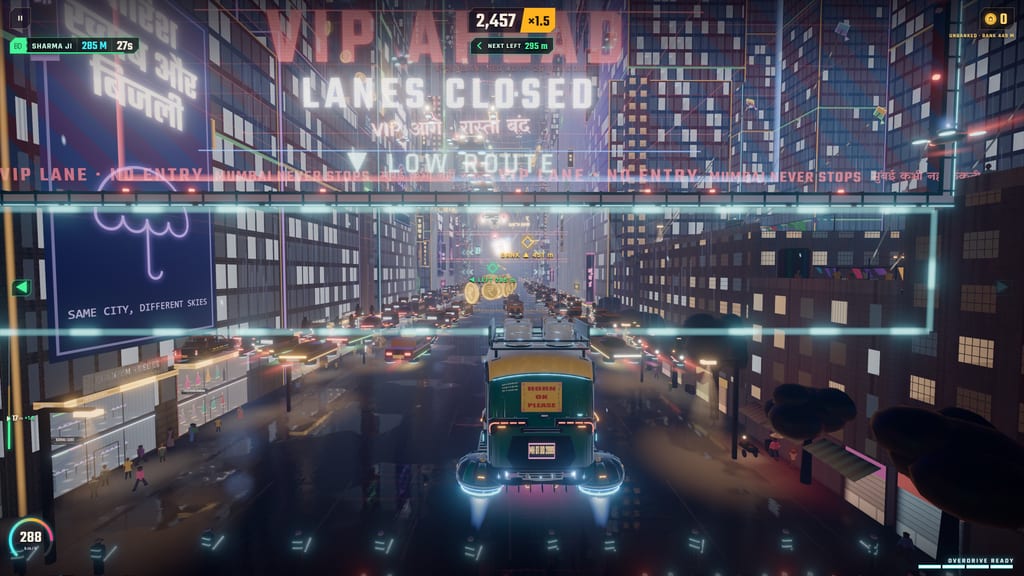
The brands are invented, down to Mumbai Bijli logging your complaints. The customers are Sharma ji, Aunty D'Souza and Pinto Uncle, and one of them has ordered a robot spare part. When you crash, the dabbas burst and spill dal, rice, sabzi and chutney, and CRASHED comes with धड़ाम! (a thud). Failure can be funny without being unfair.
Respect for the phone
Most people will play this on a phone, in a queue, on a bus, and the work nobody sees is for them.
While the city loads, a dabba rides the Western line, hopping from Churchgate towards Borivali, lamp to lamp, all 22 stations, each name lighting up as it lands. It keeps its own timetable, paced to how long your phone took last time. If the game is still getting ready, it waits at Kandivali for Borivali's signal, fidgeting, with WAITING FOR THE SIGNAL on the board, which is the most honest loading message I know. Then the signal turns green, it hops in, and DABBA ARRIVED · READY TO DELIVER.
Before you play, the game quietly draws everything once: a crash, the bank, the convoy. So the first crash of a session doesn't freeze, because a stutter at the moment you die feels like the game cheated. And the frame rate is steady on purpose: every second or third refresh of your screen, never an uneven mix, because steady feels faster than quick but stuttering.
Every setting says in one plain line what it does, and a choice lights up like a neon tube catching while the old one goes dark with a last flicker. There's a reduced-motion switch, and a separate one for the lightning. The traffic lights are a red square, an amber triangle and a green circle, so colour is never the only cue. The numbers are grouped the Indian way: 1,24,560.
- number the whole city grows from
- 1
- for every delivery
- 30 s
- counts as a close shave
- 1.2 m
- of street go dark in a power cut
- 135 m
Where it goes
None of this is finished, and it isn't meant to be. Dabba Dash is a playable slice of a much bigger Neo-Mumbai. If you'd like to help build the rest of it, as a partner, a publisher or a backer, I'd love to hear from you.
Until then, START RUN says चलो! (let's go). dabbadash.talibkhan.com. Mind the local train.